 GECKO
GECKO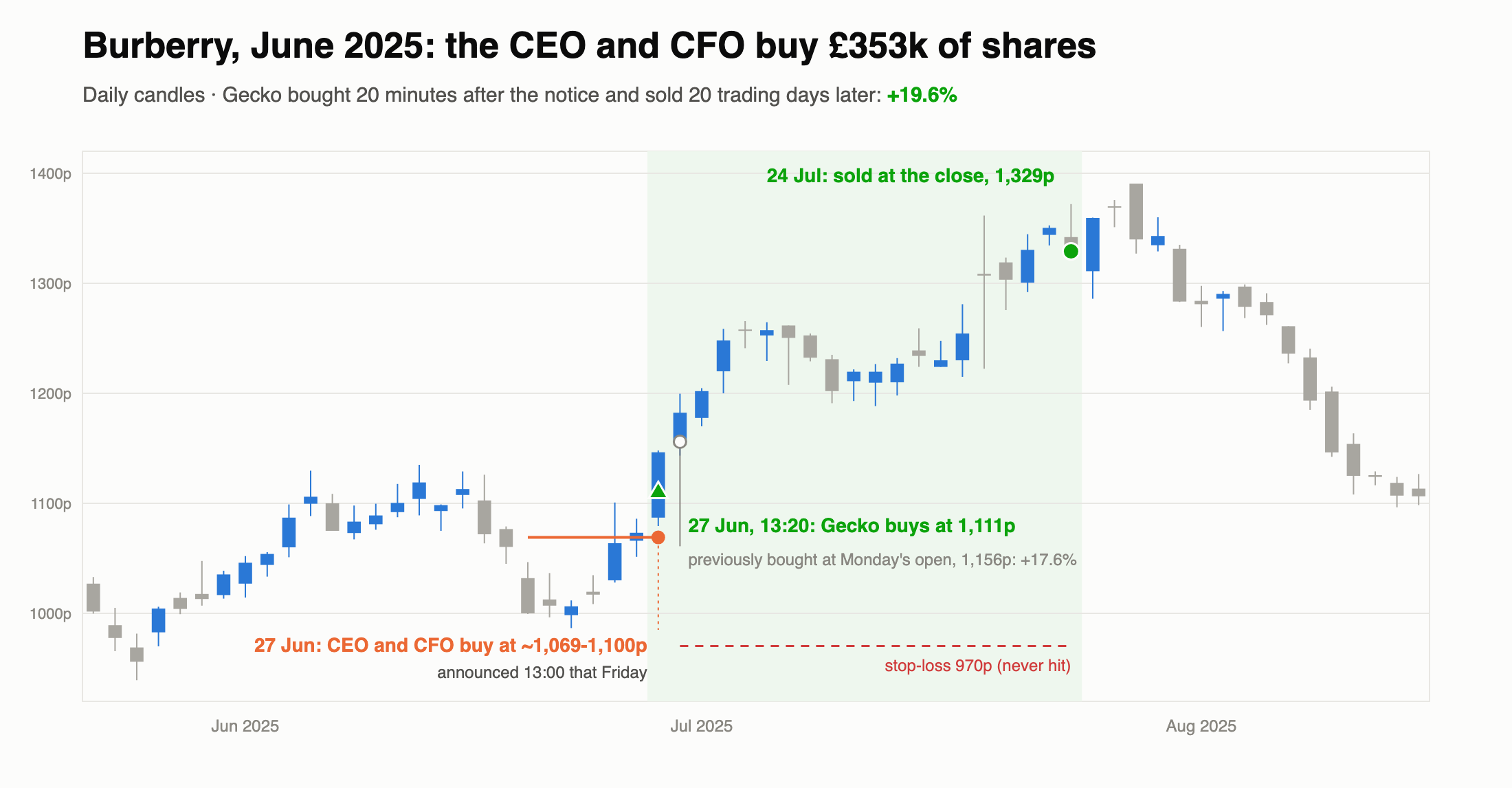
TL;DR
- The data: every time a UK company director deals in their own company’s shares, the company has to announce it. The FCA keeps every notice in a free archive. Gecko read all 33,284 for its stocks since July 2016.
- Most “dealings” aren’t decisions: share awards, bonus shares, monthly employee plans and fees paid in shares. Under one in ten is a director actually buying on the market with their own money.
- Big buys are followed by outperformance: after a director buys £250k-£5m in a day, the shares beat the market by about +1.5% on average over the next 20 trading days.
- It survives the tests the chart patterns failed: it held on the stocks Gecko was built on and on 141 FTSE 350 companies it had never seen, and in both halves of the decade.
- Tradeable, modestly - and faster is better: two-thirds of the big buys are announced while the market is open. Buying within minutes of the notice instead of at the next open, and holding 20 days, made +£6,358 over 167 trades (run #415), against +£5,360 at the next open (#411) - with almost no overlap with Gecko’s other strategies.
A concrete example: Burberry, June 2025
Burberry’s new chief executive, Joshua Schulman, bought 29,744 shares at about 1,069p - £318k of his own money - with the deal dated 27 June 2025. The finance director, Catherine Ferry, bought another £36k. The notice went out at 13:00 that Friday, in the middle of the trading day.
Waiting for the next open, as Gecko first did, the trade goes in on Monday 30 June at 1,156p, with a stop at 1,043p. Twenty trading days later, on 25 July, it sells at the close: 1,359p, +17.6%.
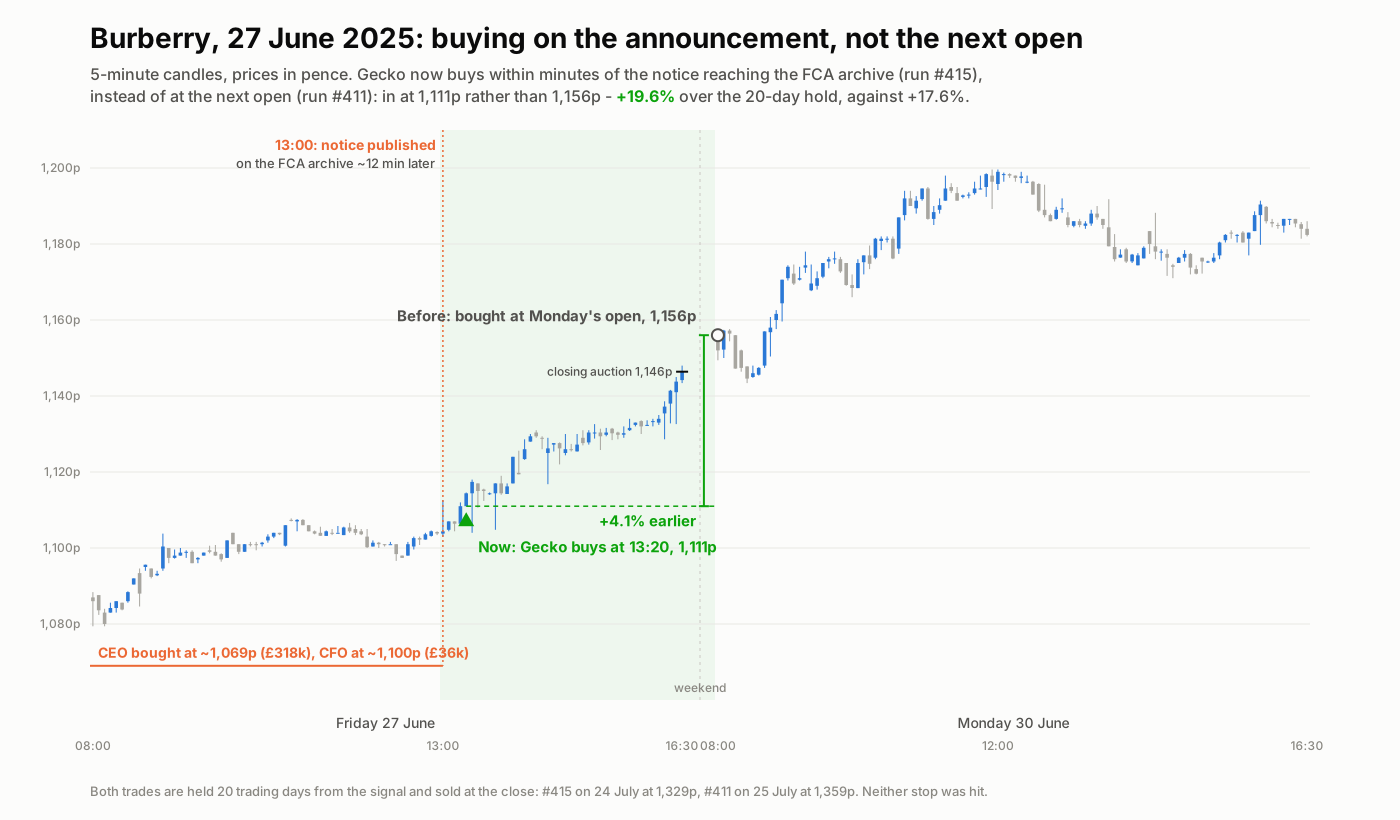
Gecko now watches the FCA archive throughout the trading day and buys as soon as a big purchase appears. The notice reached the archive about 12 minutes after it was published; the trade goes in at 13:20 at 1,111p and is sold on 24 July at 1,329p: +19.6% (the chart at the top of this page).
Two honest details from this example:
- The market reacts - but not instantly. By Monday’s open the price was about 8% above what the chief executive paid. About 3% of that came before the notice was public, and nobody outside the company can capture that part. The rest - another 4% - came between the notice and Monday’s open, and a trader watching the archive could have had it.
- It doesn’t always work. In March 2025, Bunzl’s chief executive bought £303k of shares. Gecko bought the next open at 3,068p - and was stopped out at 2,895p, -5.6%. Across all the trades, only about half win. The edge comes from the winners being bigger than the losers.
What a director dealing is
Under the UK Market Abuse Regulation, a “person discharging managerial responsibilities” (PDMR) - directors and other top executives - must tell the company and the FCA within three business days whenever they or their close family deal in the company’s shares, and the company must publish it. Since July 2016 every notice uses the same template: who, their role, the share’s ISIN, the nature of the transaction, the price and volume, the date and the place.
That standard template is what makes this usable. Gecko reads each notice, works out what kind of dealing it is from the “nature of the transaction” line, and values it against the day’s share price.
Most dealings say nothing
Across the ten years, of the 70,030 dealings in Gecko’s stocks:
| Kind of dealing | Count | Says something about the price? |
|---|---|---|
| Plan purchases (monthly employee plans, fees paid in shares, trustee buys) | 25,724 | No - automatic |
| Share awards and vesting | 20,769 | No - pay |
| Open-market buys | 6,712 | Yes - a director’s own decision |
| Share incentive plans | 4,816 | No |
| Option exercises | 4,518 | Rarely - often sold straight away |
| Sales | 4,179 | Weakly (see below) |
| Transfers, dividend reinvestment, other | 3,255 | No |
The first version of the sorting rules counted a third more “buys” than there really were, until plan purchases dressed up as purchases (“acquisition of shares under the share reward plan”) were given their own category.
What happened after the buys
For each buy, Gecko took the first price a trader could actually have traded at after the announcement and measured the return over the following days, minus the average stock’s return over the same days - so a rising market can’t flatter the result.
| Director buys | Buy days | After 5 days | After 10 days | After 20 days |
|---|---|---|---|---|
| All | 3,981 | +0.18% | +0.19% | -0.04% |
| £50k or more | 1,779 | +0.36% | +0.46% | +0.44% |
| £250k-£5m | 512 | +0.53% | +1.02% | +1.70% |
| Strategic stakes over £5m | 45 | -0.69% | -0.77% | -1.07% |
Size matters: small purchases barely move anything, and the very largest are usually founders’ investment vehicles building long-term stakes, which say something different. The £250k-£5m band is where conviction shows. It held up when the data was split:
- 2016-2020: +3.05% after 20 days. 2021-2026: +1.10% - smaller, but still positive (see Has it weakened? below).
- The 109 stocks Gecko was developed on: +1.43%. 141 FTSE 350 companies it had never seen: +1.85%.
That last split is the one that matters most. When Gecko ran the same check on EVS Drift, its edge vanished on the new stocks. This one didn’t.
Some things that the research literature suggests, Gecko didn’t find: buys by the chief executive or finance director weren’t stronger than other directors’, and several directors buying together wasn’t stronger either.
Has it weakened since 2021?
At first sight, yes: the 20-day effect was much bigger in 2016-2020 than since. Two explanations were worth checking - that faster, automated traders now grab the move before anyone else can act, or that one unusual period flattered the early years. Gecko split each big buy’s move into the part that happens before a trader can act (from the last close before the announcement to the open they’d buy at) and the part after buying:
| Period | Big buys | Before you can act | 20 days after buying |
|---|---|---|---|
| 2016-2020 | 158 | +1.19% | +2.77% |
| …of which 2020 alone | 52 | +1.73% | +5.36% |
| 2016-2019 | 106 | +0.93% | +1.49% |
| 2021-2023 | 204 | +0.49% | +1.39% |
| 2024-2026 | 151 | +0.66% | +0.36% |
- It’s mostly Covid. Directors who bought during the 2020 crash, when markets were in panic, were rewarded hugely as prices rebounded. Leave 2020 out and the years before and after look almost the same: +1.49% against +1.39%.
- Not faster traders. If machines were reacting first, the move before a trader can act would have grown. It shrank.
- The last two years are weaker (+0.36%), but with 151 buys the uncertainty is about ±0.7% - too few to tell a real change from chance. That is what Gecko’s forward test will watch.
The Covid episode also hints at a sharper version of the signal: directors buying after a big fall, when they have the strongest reason to think the market has got it wrong.
The backtest
Turned into a Gecko strategy - buy after a director buy of £250k-£5m, stop at 2.5x the average daily range, sell after 20 trading days - and run through Gecko’s full engine as CFDs on a £10,000 account at 2% risk, with realistic 5-minute fills, commission, spread and overnight financing. The question that turned out to matter most was when to buy:
| Run | Timing | Trades | Won | Net after costs | Per trade, after costs |
|---|---|---|---|---|---|
| #385 | at the open after Gecko’s 17:00 evening scan | 169 | 50% | +£4,409 | +0.13R |
| #411 | at the first open after the announcement | 168 | 52% | +£5,360 | +0.16R |
| #415 | 15 minutes after an announcement during market hours; otherwise the next open | 167 | 53% | +£6,358 | +0.19R |
The first version scanned only in the evening, so a 7am announcement was bought a day late; a 07:30 scan fixed that (#411). The bigger gap was the announcements made during the day - two-thirds of the big buys come out while the market is open, most of them between 10:00 and 16:30, and waiting for the next open meant buying after the price had moved. Measured on 5-minute prices, it rose by a further +0.7% on average between just after the announcement and the next open, and was higher at the open two times in three.
So Gecko now checks the FCA archive every two minutes through the trading day and buys as soon as a big purchase appears (#415). Two checks that the gain is real:
- The archive’s delay doesn’t matter. Notices reach the FCA archive about 12 minutes after they’re published. Buying 5, 15 or 25 minutes after publication made almost the same (+£6,265, +£6,358, +£6,500) - the market absorbs this news over hours, not seconds.
- It isn’t the stop. Buying earlier also puts the stop, set from the previous close, further below the entry. Measured from the actual entry price on both sides instead, buying on the announcement still came out ahead: +£5,923 against +£4,047.
Other details, for #415:
- Profitable in 9 of 11 years, and +£2,797 since 2023.
- Gentle drawdowns: in a bad year (1 in 20) the simulation expects a fall of about 6R, against 11R for EVS Drift.
- The signal days beat random entries 96% of the time on the original stocks and over 99% on the new ones (tested on the next-open version, #385).
- Almost no overlap with Gecko’s other strategies - one trade in common with EVS Drift, five with the spike low. It’s a third, independent signal.
- It’s rare: about 16 trades a year on Gecko’s original stock list.
What about director selling?
Directors’ sales were followed by a small underperformance (about -0.6% over 20 days) - real, but a third of the size of the buying effect, and too small to profit from by shorting after costs. Directors sell for all sorts of reasons: tax, a house, spreading their wealth. They buy for only one. Using a recent sale as a warning sign on other strategies’ tips didn’t reliably help either.
Verdict
Cautiously promising. This is the first edge Gecko has found from information outside the price chart, and the first since EVS Drift to pass the test of stocks it had never seen. The caveats are real: only half the trades win, the last two years have been weaker (though not yet distinguishable from chance), and part of every move happens before anyone outside the company can act. Gecko now checks the FCA archive every two minutes through the trading day, shows each stock’s director dealings on its page, and turns each big director buy into a tip within minutes - sent straight to the paper account first.