 GECKO
GECKO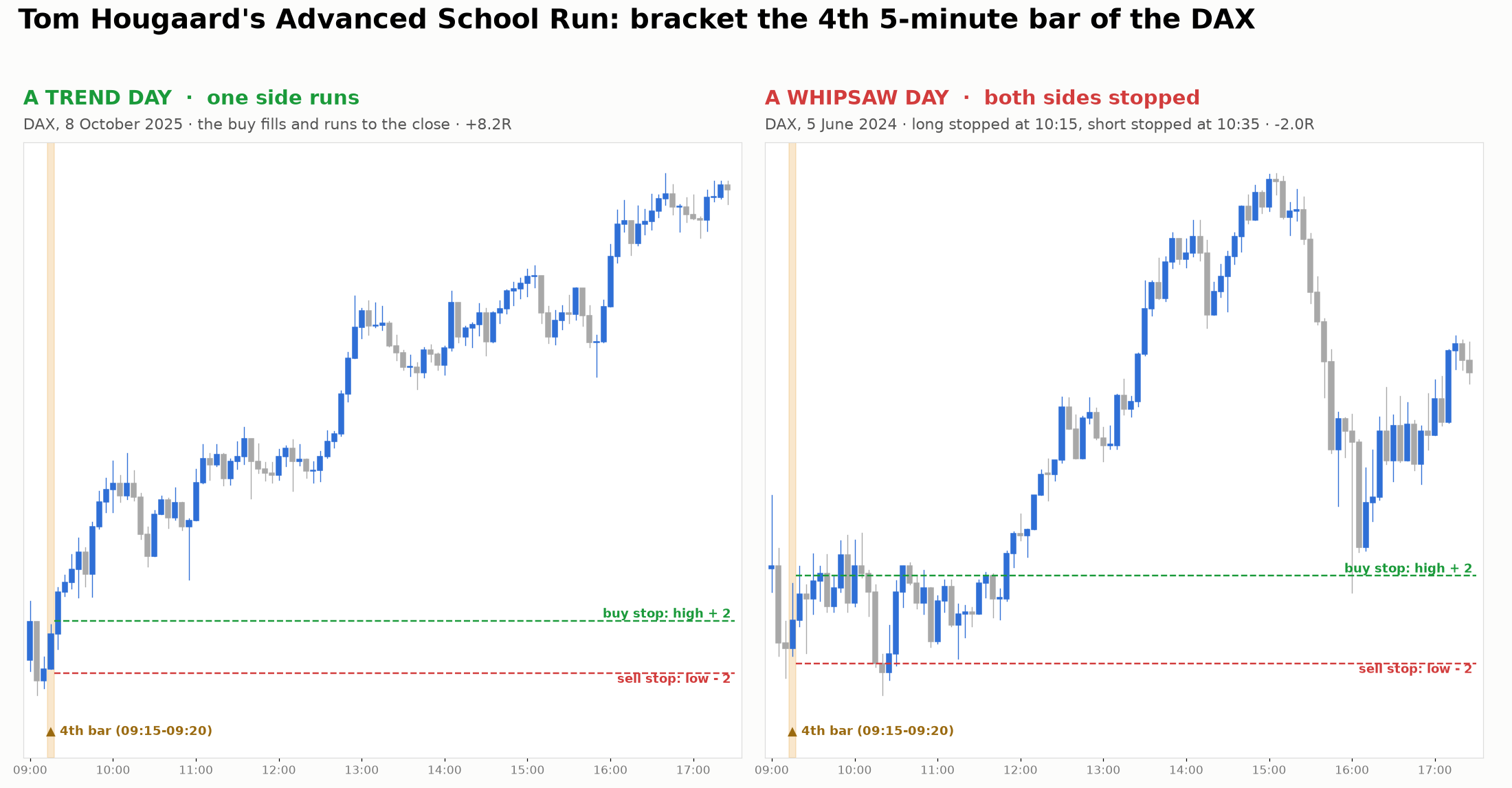
TL;DR
- The strategy: Tom Hougaard - day trader and author of Best Loser Wins - published the Advanced School Run in 2023. Wait for the DAX’s 4th five-minute bar after the 9am open, put a buy order just above it and a sell order just below, and use each order as the other one’s stop.
- It has a real edge before costs. On 14 years of one-minute data, about +0.15R to +0.18R a trade on the DAX, positive in 14 of 15 years (2023 was flat) - and much the same on the Euro Stoxx 50, Nikkei 225 and Hang Seng. It doesn’t work on the FTSE or the Dow.
- Costs take all of it. Gecko measured IBKR’s actual CFD spreads at the time these orders fill and added its commission: a DAX round trip costs about 6.5 points, roughly the size of the edge. After costs, every market comes out between about +0.00R and -0.10R a trade.
- Cautiously interesting, not tradeable as CFDs. The edge would survive at futures-level costs (about 2 points on the DAX), but that’s untested and needs a futures account.
Where the strategy comes from
Tom Hougaard is a Danish trader best known for trading live in front of his followers and for his book Best Loser Wins, on the psychology of taking losses. He shares research with his followers, including two DAX opening strategies he calls the School Run and the Advanced School Run (ASRS) - named because they happen around the time European parents are doing the school run.
The idea behind them is his: in the first quarter of an hour of the DAX’s trading day, banks and brokers are busy filling orders their clients placed overnight. Once that’s done, a break of a clean five-minute bar is more likely to show where the market really wants to go.
The rules below are Gecko’s paraphrase of his published description. The strategy, its name and the idea behind it are Tom Hougaard’s; any mistakes in turning it into code are Gecko’s.
The rules
| Tom’s rule | How Gecko coded it |
|---|---|
| Watch the DAX on a 5-minute chart from the 9am Frankfurt open | IBKR’s Germany 40 CFD, cash session 09:00-17:30 Frankfurt time |
| The signal bar is the 4th five-minute bar (09:15-09:20) | the high and low of 09:15-09:20 |
| Buy 2 points above its high, sell short 2 points below its low | stop orders, live from 09:20; filled at the order price, or at the open if a bar jumps past it |
| The stop is wherever the other order is | a long’s stop is the sell order and vice versa - a failed long becomes a short at the same price |
| No profit target | held to the cash close (breakeven moves and targets tested too) |
Each side can trigger once a day, so a day has only a few possible stories - the header shows the two that matter. On a trend day one order fills and runs: 8 October 2025 made +8.2R from a single long. On a whipsaw day both orders fill and both get stopped: on 5 June 2024 the long was stopped at 10:15, the short at 10:35, for -2R - and then the DAX trended anyway, without it.
What happened on the DAX
Gecko first tested it on five-minute bars, and hit a problem: with a stop only about 24 points away, a single five-minute bar often reaches both the entry and the stop, and the bar alone can’t say which came first. So the results came out as a range, from about +0.05R (assume the worst every time) to +0.14R (decide by the bar’s colour). Gecko then downloaded one-minute bars back to 2012 - three million of them for the DAX - which settled it. On one-minute bars the two methods agree, and the “decide by the bar’s colour” estimate turned out to be right.
| DAX, 4th bar, 2012-2026 (6,300 trades) | Profit per trade, before costs |
|---|---|
| Hold to the close (Tom’s no-target rule) | +0.15R to +0.17R |
| Move the stop to breakeven after +1R | +0.16R to +0.18R |
| Take profit at 2R | +0.07R to +0.09R |
Before costs it made money in 14 of the 15 calendar years from 2012 to 2026, from +0.04R a trade (2026 so far) to +0.33R (2025); 2023 was flat. What a typical run feels like is less comfortable:
- About six days in ten lose, most of them whipsaws costing about -2R.
- About four in ten win, averaging +3.6R.
- The best tenth of days make well over half the profit. Skip a few of the days you can’t predict, and the edge is gone.
Gecko also tried two variations: taking only the first order to fill (no reversal), and skipping signal bars that were unusually narrow or wide compared with the last 20 days. Both helped a little - the best combination reached about +0.19R a trade before costs - but that’s the best of 24 combinations tried, so some of its advantage is luck in the picking.
Other markets
The rule only needs a market with a clear daily open, so Gecko ran the same thing on IBKR’s other index CFDs, measuring from each market’s own cash open.
| Market (one-minute bars, 2012-2026) | Profit per trade, before costs |
|---|---|
| DAX | +0.15R to +0.17R |
| Euro Stoxx 50 | +0.16R to +0.18R |
| Nikkei 225 | +0.22R |
| Hang Seng | +0.13R to +0.14R |
| Dow Jones | +0.05R to +0.07R |
| FTSE 100 (five-minute screen) | about 0, or worse |
So it isn’t a DAX quirk - it looks like a genuine opening-hour effect, strongest in Europe and Asia, weak in the US and absent in London. That fits Tom’s own view that the FTSE needs different tools.
Then come the costs
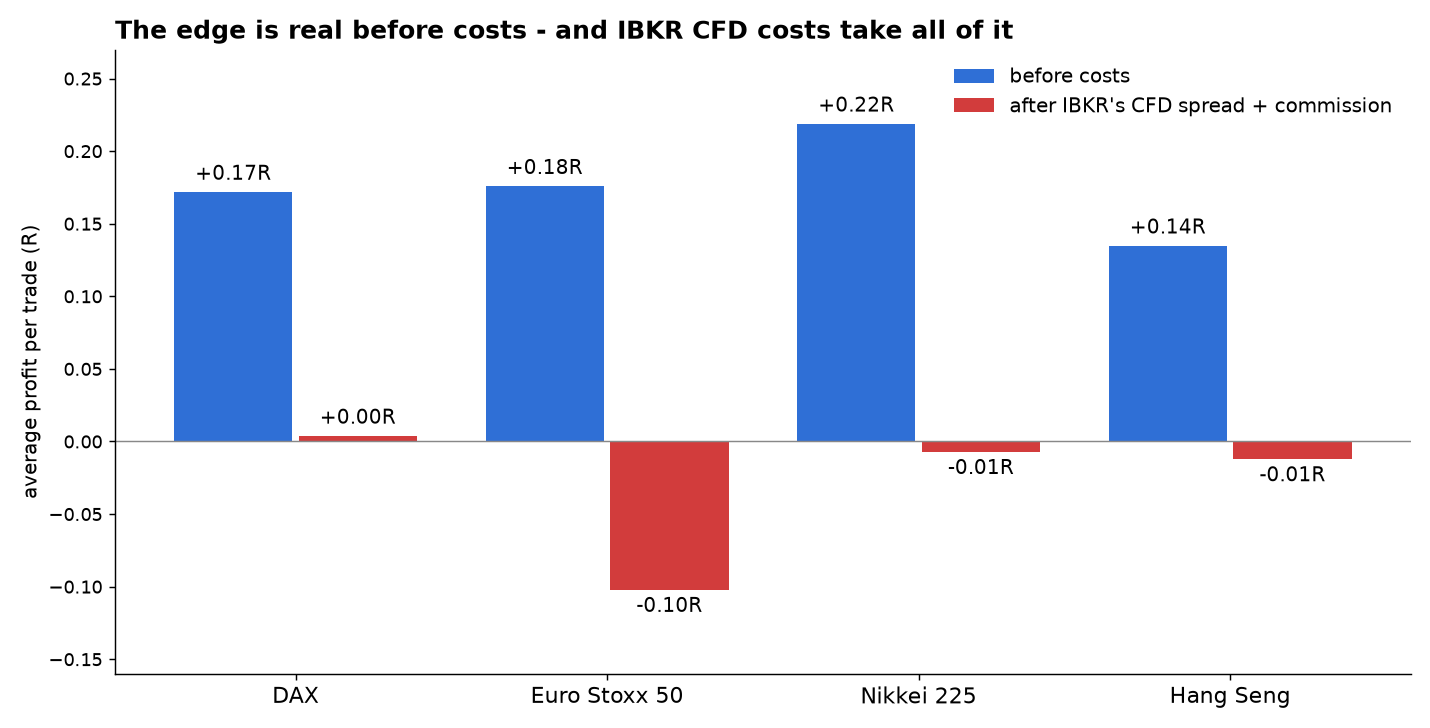
An edge of +0.17R on a 24-point stop is worth about 4 DAX points a trade. To find out what trading it would cost, Gecko asked IBKR for its historical bid and ask prices for each CFD over the last 6-12 weeks, at exactly the time ASRS orders fill (the ten minutes after the signal bar), and added IBKR’s published commission:
| Market | Spread when the orders fill | Commission (round trip) | Total cost | Profit per trade after costs |
|---|---|---|---|---|
| DAX | 4.1 points (0.016%) | 0.010% | about 6.5 points | +0.00R |
| Euro Stoxx 50 | 1.4 points (0.022%) | 0.020% | -0.10R | |
| Nikkei 225 | 10 points (0.015%) | 0.020% | -0.01R | |
| Hang Seng | 3.4 points (0.014%) | 0.020% | -0.01R |
The edge and the cost are almost exactly the same size. The DAX comes closest only because IBKR charges half the commission on it; Nikkei has the biggest edge, but double the commission eats it. None of these figures yet includes slippage - stop orders at a busy moment often fill a point or two worse - so the real picture is slightly worse again.
This also explains how Tom can trade it profitably: he has been open about choosing a broker with exceptionally tight spreads, and a strategy like this lives or dies on them.
Could it work another way?
Probably only through futures. IBKR’s Micro DAX future (€1 a point) and Mini DAX (€5 a point) charge about 0.3-0.8 points in commission and usually trade with a spread of about a point - roughly 2 points a round trip instead of 6.5. At that cost the DAX version keeps about +0.05R a trade, or +0.10R with the best variation. That’s small, it still leaves out slippage, and the futures spread here is a typical figure rather than one Gecko measured. It would need a futures account and a spell of paper trading before anyone should believe it.
Verdict
Cautiously interesting - but not tradeable as an IBKR CFD. Tom Hougaard’s Advanced School Run is one of the few ideas Gecko has tested that shows a real, consistent edge before costs: across 14 years (all but one positive), four markets on two continents, and settled on one-minute data. But the edge is worth about the same as the cost of a CFD round trip, so after costs it makes nothing. Whether it pays depends entirely on how cheaply it can be traded - and the only cheap enough route, futures, is still untested.